
Pylon Review
Pay-per-project solar design and proposal software from Sydney, with 3D shading, battery design and an optional solar CRM
Fit Score
Fit Score
▸ How we scored Pylon: 10.0/10
| Factor | Weight | Sub-score |
|---|---|---|
| Vertical fit (best trade) | 60% | 10.0/10 |
| Pricing transparency | 20% | 10.0/10 |
| Integration coverage | 20% | 10.0/10 |
Weighted composite, applied identically to every vendor; no vendor pays to change it. Full Fit Score methodology →
WrenchStack may earn a commission or a referral reward if you sign up through a tracked link on this page. The vendor pays it and we add no charge of our own. Neither is an input to the Fit Score or to how we order tools. How we make money.
Quick verdict
Pylon is best for Solar installers in Australia and the UK who want fast residential or commercial designs and proposals without a monthly subscription. Pricing is published as module or per-project prices (see the pricing note). Trade fit of 8/10 or higher: Solar.
Reviews on review sites
We do not copy third-party review scores onto this page: they change often and we could not verify them. Read Pylon's current reviews at the source.
About Pylon
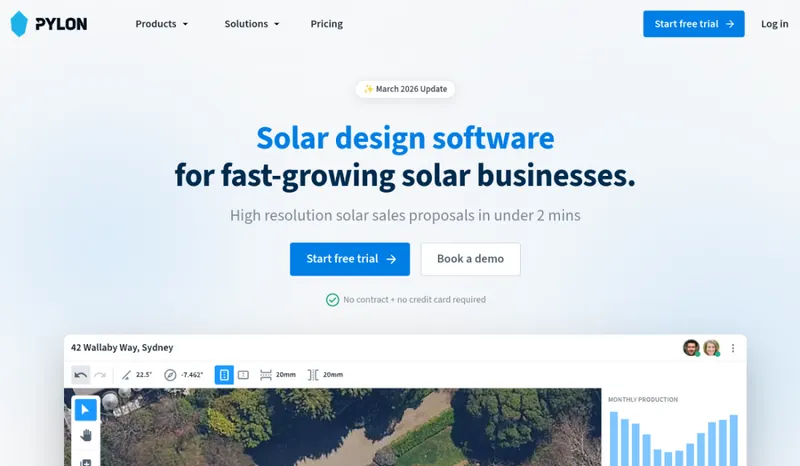
Pylon is solar design and proposal software made by Saru Technologies Pty. Ltd. in Sydney, Australia. Designers place panels on high-resolution imagery or on an uploaded blueprint or drone photo, run 3D shading simulations, and choose hardware from a library that Pylon says holds over 20,000 panels, inverters and batteries. Proposals come out as web pages and PDFs, and Pylon advertises solar proposals in 2 minutes.
Other tools include battery design with savings modeled against real electricity tariffs, automatic single-line diagrams (editable in Pylon since a July 2026 update), voltage rise reports, installer job sheets, customer owner's manuals and e-signatures. The main site is built for Australia, with Australian retailers, incentives and finance partners. A separate UK site covers MCS calculations, and the July 2026 update added MCS roof splitting for UK installers.
Pylon charges per project instead of a subscription. The main site lists Standard at $4.00 per project and Pro at $10.00 per project without labeling the currency, while the UK site shows £4.00 and £10.00. Pro adds custom load profiles, battery storage design and commercial-sized projects. A project is one address with up to five designs, and revisiting or editing a project costs nothing extra. New users get free credits for five Standard projects with no credit card, there is no monthly minimum, and teams can add unlimited users. Enterprise (single sign-on, API support, dedicated support) is quoted. The Solar CRM add-on starts at $49 per user per month, and the payment gateway charges 2.5% per transaction.
Integrations include Xero, ServiceM8, Mailchimp, Nearmap imagery, finance providers Brighte, Smart Ease and Solaris Finance, lead sources SolarQuotes, SolarChoice and Facebook Lead Ads, and Google Workspace and Microsoft 365. Pylon also offers an API with webhooks. The trade-off: pay-per-project pricing is cheap to try, but high-volume teams should compare the per-project total with a flat subscription, and installers outside Australia and the UK should confirm imagery, equipment and incentive support for their market first.
Pricing
| Tier | Price | Notes |
|---|---|---|
| Standard (per project) | See pricing note | |
| Pro (per project) | See pricing note | |
| Enterprise | See pricing note |
Pay per project, with no subscription and no monthly minimum. The main (Australian) site lists Standard at $4.00 per project and Pro at $10.00 per project without labeling the currency; the UK site lists £4.00 and £10.00. New users get free credits for five Standard projects with no credit card. A project is one address with up to five designs, and revisits and edits are free. Unlimited team users. Enterprise (SSO, API support, dedicated support) is quoted. Add-ons: Solar CRM from $49 per user per month billed monthly; payment gateway 2.5% per transaction. Verified against getpylon.com/pricing and getpylon.com/uk/pricing 2026-09-29.
Pylon publishes its prices, but not as a monthly plan: see the pricing note for its module or per-project prices, and compare the total over the period you expect to use it.
Pricing verified 2026-09-29. Prices can change, so confirm them with Pylon before purchasing.
Pylon has no published monthly price we can model at your team size, so we do not estimate one: any figure here would be a guess. See the pricing note for its published prices.
Key features
Integrations
Pros
- + No subscription
You pay per project with no monthly minimum, and new users get free credits for five Standard projects with no credit card.
- + Unlimited team users
Pylon lets you add unlimited users to your team, so design costs depend on projects, not seats.
- + Fast proposals
Pylon advertises solar proposals in 2 minutes, delivered as web and PDF proposals with e-signatures.
- + Large equipment library
Pylon says its library holds over 20,000 panels, inverters and batteries, with filters for phases, type and MPPTs.
- + Battery and commercial work on Pro
Pro projects add battery storage design, custom load profiles and commercial-sized projects.
- + Install paperwork included
Single-line diagrams, voltage rise reports, installer job sheets and owner's manuals come out of the same design.
Cons
- − Australia first
The main site, incentives, retailers and finance partners are Australian. There is a UK site but no US version, so installers elsewhere should confirm coverage.
- − Currency not labeled
The main pricing page shows prices with a plain $ sign and GST notes. Confirm the currency and tax treatment for your country before budgeting.
- − Costs add up at volume
Per-project pricing is cheap to start, but a busy team should compare its monthly project total with flat-subscription tools.
- − CRM costs extra per user
The Solar CRM add-on starts at $49 per user per month, billed monthly, on top of project charges.
- − Imagery varies by country
Pylon says high-resolution imagery is available in select countries. Elsewhere you may need to upload a blueprint or drone photo.
Implementation
Use the five free Standard project credits (no credit card) to design a few recent jobs and check imagery quality, shading results and whether your equipment is in the component library. If you sell batteries or do commercial work, upgrade a test project to Pro to try those tools. Set up proposal branding, tariffs and finance options, and connect Xero or ServiceM8 if you use them. Invite your team, since users are unlimited. Decide whether you need the Solar CRM add-on (from $49 per user per month) or keep using your current CRM, and contact Pylon support for API access if you want to connect other systems. Track your monthly project count for a few months to compare per-project costs with subscription tools.
Best for / Watch out for
Best for
Solar installers in Australia and the UK who want fast residential or commercial designs and proposals without a monthly subscription
Watch out for
Built mainly for the Australian market, with a separate UK site and no US-specific site or pricing; the currency on the main pricing page is not labeled; the CRM is a separate per-user subscription; per-project charges add up at high volume
Available for these trades
Alternatives to Pylon
Matched on tool type, shared trades, price tier and team size.
Publishes its price: from $135 per user a month; also strong for solar.
Has a free tier; also strong for solar.
Publishes its price: from $233.25 a month for the company; also strong for solar.
Quote-only pricing, so compare on fit not cost; also strong for solar.
Quote-only pricing, so compare on fit not cost; also strong for solar.
Has a free tier; 30-day free trial.
User reviews
Write a review →No user reviews yet for Pylon
If you use Pylon, you can write the first review. Every review is moderated by hand before it is published.
Write the first review →Write a review of Pylon
Every review is moderated by hand before it is published, and a review can be declined. If you leave an email address, we may use it to confirm that you use Pylon.
Frequently asked questions
How much does Pylon cost?
Pylon charges per project with no subscription or monthly minimum. The main (Australian) site lists Standard at $4.00 and Pro at $10.00 per project without a currency label; the UK site shows £4.00 and £10.00. New users get five free Standard project credits. Enterprise is quoted, and the Solar CRM add-on starts at $49 per user per month.
Can Pylon design commercial systems?
Yes, on Pro projects. Pylon's pricing page lists commercial-sized projects as a Pro feature, and its HelioScope comparison page quotes $10 per commercial project.
Is Pylon available in the US?
Pylon's main site targets Australia, and it runs a separate UK site. We did not find a US-specific site or US pricing, so US installers should confirm imagery, equipment and incentive support with Pylon before relying on it.
What does Pylon integrate with?
Xero, ServiceM8, Mailchimp, Nearmap, finance providers Brighte, Smart Ease and Solaris Finance, lead sources SolarQuotes, SolarChoice and Facebook Lead Ads, and Google Workspace and Microsoft 365. It also has an API with webhooks; Pylon says using the API carries no extra charge.
Who makes Pylon?
Saru Technologies Pty. Ltd., based in Sydney, Australia.
Ready to try Pylon?
Prices are by module or per project: see the pricing note above.
Visit Pylon →Do you build something that competes with Pylon?
We check Pylon against its own website and list the cons next to the pros. If you build a competing product that is not listed here, you can submit it for editorial review. An evaluation can end with or without a listing.
Listings are free. We do not accept payment for inclusion, for placement, for a score, or to remove a documented con. Read this page first and decide whether you want that.