
Solo Review
In-home sales and proposal software for solar, roofing, HVAC and generator installers
Fit Score
Fit Score
▸ How we scored Solo: 7.8/10
| Factor | Weight | Sub-score |
|---|---|---|
| Vertical fit (best trade) | 60% | 8.0/10 |
| Pricing transparency | 20% | 5.0/10 |
| Integration coverage | 20% | 10.0/10 |
Weighted composite, applied identically to every vendor; no vendor pays to change it. Full Fit Score methodology →
WrenchStack may earn a commission or a referral reward if you sign up through a tracked link on this page. The vendor pays it and we add no charge of our own. Neither is an input to the Fit Score or to how we order tools. How we make money.
Quick verdict
Solo is best for Residential solar sales teams, and roofing, HVAC and generator installers selling in the home, that want fast proposals with built-in financing and the option to have Solo's team do the design. Pricing is quote-only (no published price). Trade fit of 8/10 or higher: Solar.
Reviews on review sites
We do not copy third-party review scores onto this page: they change often and we could not verify them. Read Solo's current reviews at the source.
About Solo
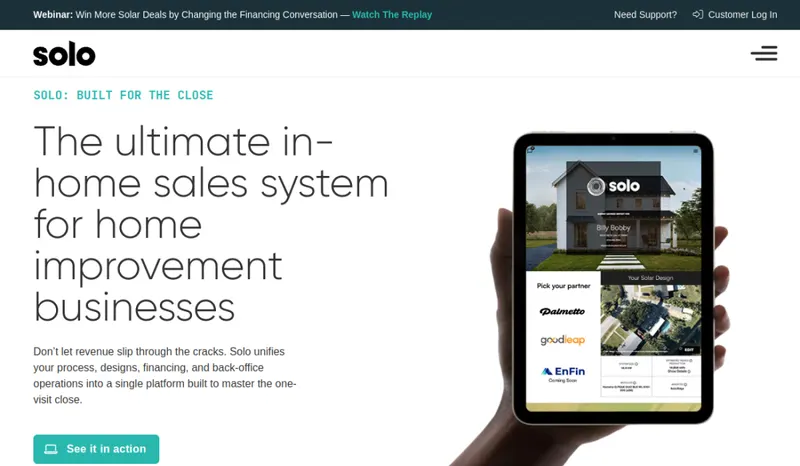
Solo is in-home sales and proposal software for home improvement companies, starting with residential solar. It is run by Speed of Light Ops, LLC, doing business as Solo, and is based in Lehi, Utah. Solo says more than 6 million proposals have been built on the platform and more than 1 million installations have come from them. It now sells separate Studios for solar, roofing (launched July 2026), HVAC and generators.
For solar, reps can design and present in the same sitting. Solo Studio detects rooflines and obstructions with AI, adds setbacks, models shading and performance, suggests panel layouts, and checks the design against lender and code requirements. Solar Studio turns that into a branded, interactive proposal with multiple lender options built in. If you do not want to design in-house, Solo Concierge has Solo's team build the design and proposal; Solo says a complete, install-ready proposal arrives in minutes.
Solo leans on production accuracy. It says its production estimates carry '99.9% certified accuracy verified across 1,400+ homes', publishes a DNV report comparing its engine with the real output of installed systems, and says its internal design check typically cuts change orders by 15%. Solo lists more than 70 integrations, including Salesforce, HubSpot, Pipedrive, Zoho, JobNimbus, Enerflo and DocuSign, and lenders such as GoodLeap, Mosaic, Sungage, Dividend, Sunlight Financial and LightReach.
Prices are not published. Solo's pricing page offers plans based on usage, support level and scale; every plan includes unlimited users, concierge onboarding and support, and you book a demo for a quote. Support runs Monday to Friday 8am to 8pm and Saturday 8am to 4pm Mountain time (Saturday for Professional Support only).
The trade-off: without published prices, you cannot compare Solo's cost until you get a quote, and because plans are based on usage, confirm how cost changes with your volume. Solo is built around the homeowner sale; its pages do not advertise permit plan sets or engineering stamps, so plan that work separately.
Pricing
| Tier | Price | Notes |
|---|---|---|
| Usage-based plans (book a demo) | Custom quote |
No public prices. Solo's pricing page offers flexible plans based on usage, support level and scale, and every plan includes unlimited users, a concierge onboarding program and support. Book a demo for a quote. Verified against gosolo.io/pricing 2026-10-08.
Solo does not publish a price, so you need a quote before you can compare it (49 of the 127 tools we list are quote-only). A missing price is not evidence of a high one. Get the quote in writing and confirm what it includes (number of users, integrations, onboarding, support) before you sign.
Pricing verified 2026-10-08. Prices can change, so confirm them with Solo before purchasing.
What the quote depends on
Usage, support level and scale.
Source: gosolo.io/pricing, read 2026-10-08.
Solo has no published monthly price we can model at your team size, so we do not estimate one: any figure here would be a guess. Ask Solo for a quote.
Key features
Integrations
Pros
- + Design done for you if you want it
Solo Concierge has Solo's team build the design and proposal, and Solo says an install-ready proposal arrives in minutes. Teams that want control can design in Solo Studio and use Solo's design service for overflow.
- + Accuracy backed by a published report
Solo says its production estimates carry '99.9% certified accuracy verified across 1,400+ homes' and publishes a DNV report comparing its engine with the real output of installed systems.
- + Built for the kitchen-table sale
Reps can go from conversation to a ready-to-present proposal without leaving the in-home presentation, with multiple lender options and e-signature in the same flow.
- + Unlimited users on every plan
Solo's pricing page says every plan includes unlimited users, concierge onboarding and support, so adding reps does not add seat costs.
- + Broad integrations
Solo lists more than 70 integrations, including Salesforce, HubSpot, Pipedrive, Zoho, JobNimbus, Enerflo, DocuSign and lenders such as GoodLeap, Mosaic, Sungage and LightReach.
Cons
- − No published pricing
Solo quotes plans based on usage, support level and scale, so you cannot compare cost without booking a demo.
- − Usage-linked cost
Solo's pricing page says plans are based on usage, support level and scale. Ask how cost changes with your volume and get the quote's assumptions in writing so you can budget.
- − No advertised permit package
Solo focuses on the sale. Its pages do not advertise permit plan sets or engineering stamps, so you still need a way to produce permit-ready drawings.
- − Non-solar track record is shorter
Solo's proof points (proposal counts, accuracy report, installations) come from solar. Roofing Studio launched in July 2026, so non-solar buyers should ask for references in their own trade.
Implementation
Book a demo and get the plan terms in writing: what usage is included, the support level, and how cost changes with your proposal volume. Solo includes a concierge onboarding program on every plan. Set up your equipment, pricing, adders, lenders and proposal branding first, since every design and proposal pulls from them. Decide whether reps will design in Solo Studio, send jobs to Solo Concierge, or mix the two. Connect your CRM (Salesforce, HubSpot, Pipedrive, Zoho, JobNimbus and others are supported) and, if you use it, Enerflo, so deal data flows without retyping. Train reps on presenting and editing proposals in the home, and plan permit drawings separately.
Best for / Watch out for
Best for
Residential solar sales teams, and roofing, HVAC and generator installers selling in the home, that want fast proposals with built-in financing and the option to have Solo's team do the design
Watch out for
No published pricing (demo required) and cost tied to usage; its pages do not advertise permit plan sets or engineering stamps; Roofing Studio only launched in July 2026
Available for these trades
Alternatives to Solo
Matched on tool type, shared trades, price tier and team size.
Quote-only pricing, so compare on fit not cost; stronger solar specialty fit.
Publishes its price: from $233.25 a month for the company; stronger solar specialty fit.
Publishes its price: from $135 per user a month; stronger solar specialty fit.
Has a free tier; stronger solar specialty fit.
Publishes module or per-project prices, not a monthly plan; stronger solar specialty fit.
Publishes its price: from $25 a month base, more as users are added; 14-day free trial.
User reviews
Write a review →No user reviews yet for Solo
If you use Solo, you can write the first review. Every review is moderated by hand before it is published.
Write the first review →Write a review of Solo
Every review is moderated by hand before it is published, and a review can be declined. If you leave an email address, we may use it to confirm that you use Solo.
Frequently asked questions
How much does Solo cost?
Solo does not publish prices. Its pricing page offers flexible plans based on usage, support level and scale, and every plan includes unlimited users, a concierge onboarding program and support. Book a demo for a quote and ask how the price changes with your proposal volume.
What is Solo Concierge?
It is Solo's done-for-you design service. Solo's team builds the design and proposal, and Solo says a complete, install-ready proposal arrives in minutes. Teams that prefer to design in-house can use Solo Studio and send overflow to Solo's design team.
Is Solo only for solar?
No longer. Solo started in residential solar and now also sells Roofing Studio (launched July 2026), HVAC Studio and Generator Studio for in-home sales.
Solo vs Aurora Solar?
Aurora publishes per-user plans and sells design software plus paid services such as permit plan sets. Solo does not publish prices, includes unlimited users, and offers a done-for-you design service. Teams that do not want to staff designers often look at Solo; teams that want to own design and need plan sets from the same vendor often look at Aurora.
Does Solo produce permit plan sets?
Solo's pages do not advertise permit plan sets or engineering stamps. Solo Studio checks designs against lender and code requirements, but plan how you will produce permit-ready drawings before you rely on Solo alone.
Ready to try Solo?
No published price: ask Solo for a quote.
Visit Solo →Do you build something that competes with Solo?
We check Solo against its own website and list the cons next to the pros. If you build a competing product that is not listed here, you can submit it for editorial review. An evaluation can end with or without a listing.
Listings are free. We do not accept payment for inclusion, for placement, for a score, or to remove a documented con. Read this page first and decide whether you want that.